
Painter Co-Authors Study on Presidential Debate Rhetoric
October 08, 2021
By Stephanie Rizzo ’09
The study used tonal analysis software to determine how debate styles have changed over the years.
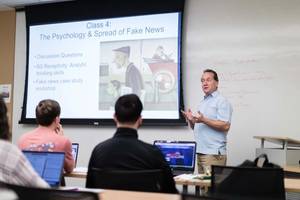
Assistant professor of communication David Painter and Juliana Fernandes, assistant professor of advertising at the University of Florida, recently published “They’re Not Just Words: The Verbal Style of U.S. Presidential Debate Rhetoric” in the journal Communication Studies.
The study used DICTION software, a computer-assisted program for determining the tone of a verbal message, to analyze the verbal style or language usage patterns of all the candidates in 35 general election and 121 primary election debates.
The analysis indicated that the increasing complexity, negativity, and polarization in our society was reflected in the decreasing levels of certainty in debate rhetoric over the seven decades since the first televised debates between Kennedy and Nixon in 1960. Further, their results indicated that Democrats’ rhetoric emphasized shared values and identities (commonality) and described tangible conditions and events (realism) that require urgent action (activity). The Republican candidates’ rhetoric, on the other hand, was more absolute (certain), idealistic (less realistic), conservative (less activity), and focused on individual liberties (less commonality) than the Democrats.
Finally, they found that Donald Trump’s debate rhetoric was significantly different from the other candidates. Whether focused on abstract principles and slogans such as winning, greatness, and patriotism, or repetitions of specific policies such as tax cuts, the border wall, trade wars, or immigration, Trump’s rhetoric was consistently exaggerated, simplistic, and repetitive compared to the 665 other candidates’ debate rhetoric.
“My interest in analyzing the candidates’ rhetoric was piqued during the 2016 campaign when Donald Trump asserted, ‘it’s just words, folks, it’s just words,’ to deflect outrage over his infamous Access Hollywood tape comments,” says Painter. “Trump repeatedly used the diminutive ‘just words’ phrase in his attacks on Hillary Clinton in 2016 and Joe Biden in 2020. In this way, Trump used the same phrase to minimize his own offensive words and to dismiss his rivals’ rhetoric while suggesting that words do not matter. Because these claims contradict a basic tenet of the communication studies discipline, I was motivated to demonstrate that the U.S. presidential candidates’ words are meaningful."
Painter adds that this work has been transformational for his career as an academic because it combines his passions for rhetorical criticism and quantitative analyses.
Read More
April 17, 2024
Makayle Kellison ’24 Earns Goldwater Scholarship
Makayle Kellison ’24 has earned a Goldwater Scholarship, the country’s most prestigious undergraduate scholarship for the STEM fields.
April 16, 2024
Class News: April 2024
In this monthly roundup, get the latest on what’s happening in the lives of your fellow Tars.
April 08, 2024
The Legacy of Fred Rogers '51 Lives on in Rollins' Music Department
Fred Rogers' nephew Dan Crozier, a professor of music at Rollins College, shares thoughts and memories of his uncle and previews the Mister Rogers: The Musician concert.